
Did you know? |
Can a digitizer be used as an oscilloscope? Read more...
Latest Oscilloscope News |
Evaluation of multi-channel coherent Modulation Schemes
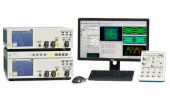 19 September 2016 – Tektronix announced a series of enhancements to its optical modulation analyzer (OMA) software. The latest release provides optical research engineers with the ability to evaluate multi-channel coherent modulation schemes with confidence using a single measurement system. Engineers can now calibrate and control multiple OMA’s to easily acquire and analyze simultaneous data from multiple channels such as different wavelengths or fiber cores.
Teledyne LeCroy launches new 10-Bit High Definition Oscilloscopes
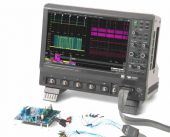 30 August 2016 - Teledyne LeCroy introduces the HDO9000 High Definition Oscilloscopes, which unveil HD1024 high definition technology that automatically optimizes vertical resolution under each measurement condition to deliver 10 bits of vertical resolution. The HDO9000 High Definition Oscilloscopes offer 10-bit resolution, bandwidths of 1 GHz to 4 GHz and sample rates of 40 GS/s, enabling efficient and accurate debug in high definition. Two units can be synchronized to operate as 8-Channel Oscilloscope without limitations, another unique feature in these high performance oscilloscopes.
Tektronix starts Delivery of Optically Isolated Probe System
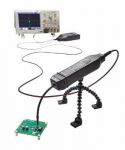 16 August 2016 - Tektronix started shipping of the IsoVu Measurement System previewed earlier this year at the APEC 2016 show. Pricing for the optically isolated measurement system starts at $12,000. IsoVu Technology combines 1 GHz bandwidth, wide common mode range, with superior Common Mode Rejection to make previously hidden signals visible.
Debugging of MIPI M-PHY Interfaces
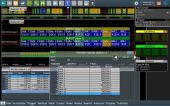 03 August 2016 - The new R&S RTO-K44 option from Rohde & Schwarz offers powerful triggering and decoding functionality for debugging designs with MIPI M-PHY based protocols. Defined as a physical layer, M-PHY serves as the basis for a number of protocol standards that have been optimized for rapid data transmission in mobile devices. For example, M-PHY is used together with CSI-3 in cameras and with UFS in memory components for multimedia applications. With DigRF Rev.4, UniPort or LLI, the interface is used in chip-to-chip communications.
Tektronix enhances Portfolio with new basic Oscilloscope
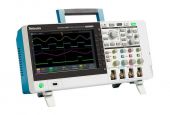 02 August 2016 - Tektronix introduced the TBS2000, a next generation basic oscilloscope featuring the longest record length and largest display in its class for faster signal evaluation and troubleshooting. This latest addition to the Tektronix portfolio puts expanded capabilities, including the ability to use a wide range of Tektronix probes, into the hands of budget-constrained design engineers and educators.
SIGLENT expands SDS1000X Series Digital Oscilloscope Series
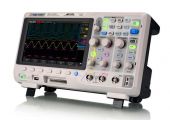 06 July 2016 - SIGLENT TECHNOLOGIES introduced the SDS1000X+ Series Super Phosphor Oscilloscope. The new SDS1000X+ is similar to the existing SDS1000X family but includes an option for 16 digital channels (MSO) and also a 25 MHz DDS arbitrary waveform generator as standard feature. The oscilloscope features also automatic measurement functions and advanced math functions.
New Release of BenchVue Software enables Data Logging with Oscilloscopes
 05 July 2016 - Keysight Technologies announced the latest release of its popular BenchVue software; an intuitive, easy-to-use platform for the PC. BenchVue provides multiple-instrument measurement applications, data capture and solution applications, without the need for instrument programming. BenchVue also supports data logging for instruments, such as oscilloscopes.
- PCI Express 4.0 Test Solution supports 16 GT/s Data Rates
- Eye Diagrams for Serial Trigger & Decode Solutions
- Hantek launched WiFi Oscilloscope
- USB Oscilloscope generates high fidelity Signals up to 40 MHz
- Thunderbolt 3 Compliance Test
- Pico Technology celebrates 25th Anniversary
- Siglent Technologies releases SDS1000DL+/CML+ Series Oscilloscope
Page 50 of 78
Oscilloscope Basics |
Oscilloscope Probes – Vital Link in the Measurement Chain
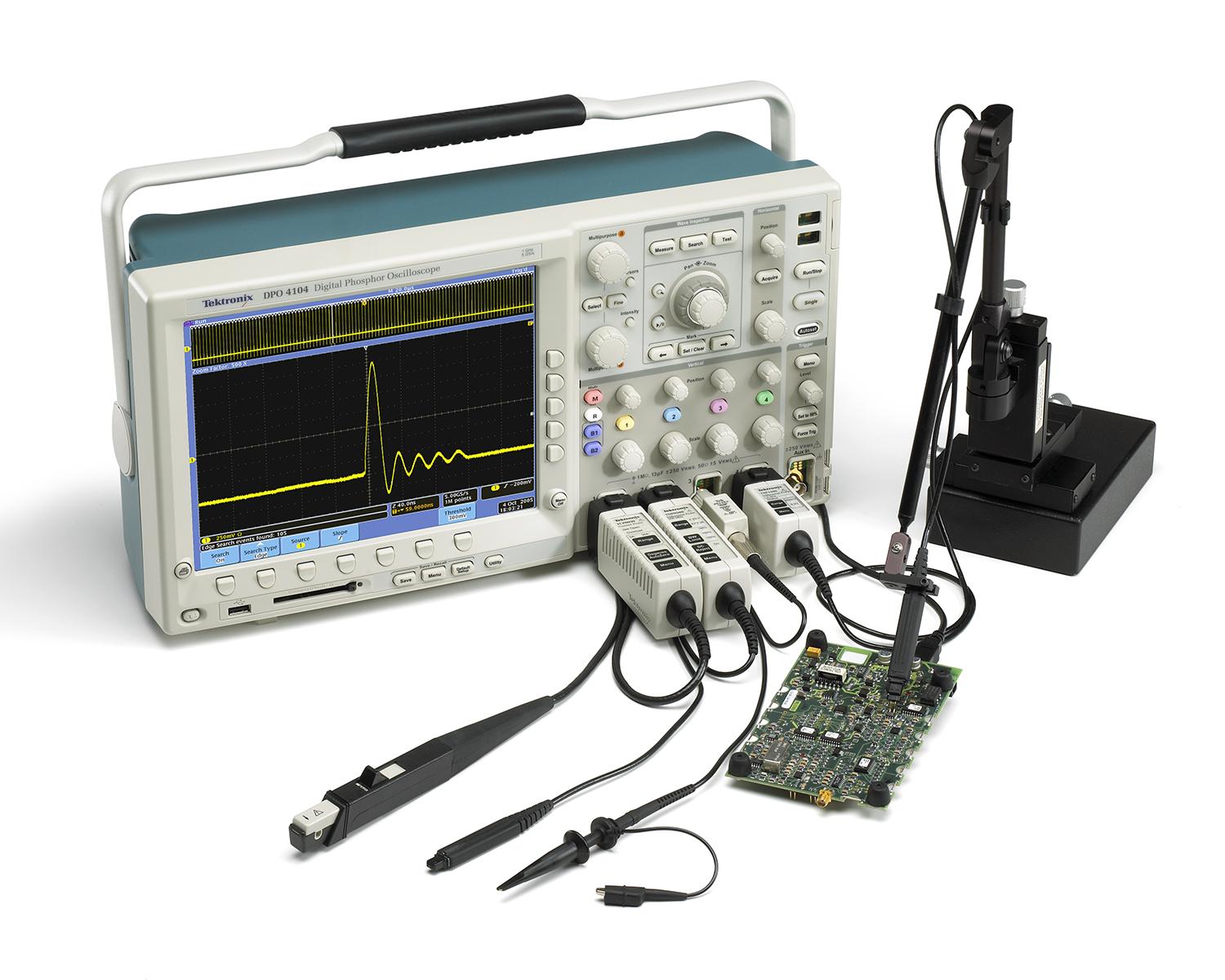 Signal measurement results can only be as accurate as the test and measurement tools in use. As clock rates and edge speeds of today’s electronic circuits increase, probing becomes a critical piece of the measurement system – the component that comes in direct contact with your circuit. This article looks at voltage probing considerations for embedded system and digital design debugging applications.
Oscilloscope Background |
A simple method to verify the bandwidth of your probe
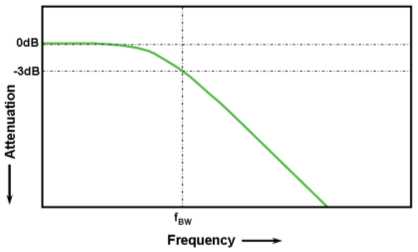 In oscilloscopes or oscilloscope probes, bandwidth is a measure of the width of a range of frequencies measured in Hertz. Specifically, bandwidth is specified as the frequency at which a sinusoidal input signal is attenuated to 70.7 percent of its original amplitude, also known as the -3 dB point. Most oscilloscope companies design the scope/probe response to be as flat as possible throughout its specified frequency range, and most customers simply rely on the specified bandwidth of the oscilloscope or oscilloscope probes, wondering if they are indeed getting the bandwidth performance at the probe tip. Now you can use these step-by-step instructions to simply measure and verify the bandwidth of your probe with an oscilloscope you may already have.