
Did you know? |
Can a digitizer be used as an oscilloscope? Read more...
Latest Oscilloscope News |
Oscilloscope Probe for use in harsh Environments
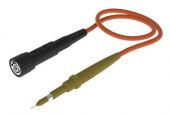 08 December 2015 - PMK launched a new 10:1 miniature-probe for Oscilloscopes with bandwidths of up to 350 MHz. The PHT 312 "ENVI"-Probe is suitable for environmental testing and designed for testing and qualification of Semiconductors in harsh environments such as service, automotive or military applications. Pure coaxial design and laser trimmed resistors ensure highest signal fidelity along the signal path offering high bandwidth and fast rise times for accurate impulse measurements.
SIGLENT Technologies releases new Super Phosphor Oscilloscopes
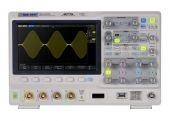 01 December 2015 - SIGLENT Technologies introduced the new SDS2000X Series Super Phosphor Oscilloscope. The SDS2000X Series is available in four bandwidths, 70 MHz, 100 MHz, 200 MHz and 300 MHz and with a maximum sample rate of 2 GSa/s. The SDS2000X Series is coming with many new features and powerful functions, such as a record length up to 140Mpts, a waveform capture rate up to 140,000 wfm/s (normal mode) and 500,000 wfm/s (sequence mode) and a hardware-based digital trigger system.
Precision Phase Noise Measurement with an Oscilloscope - Part 1
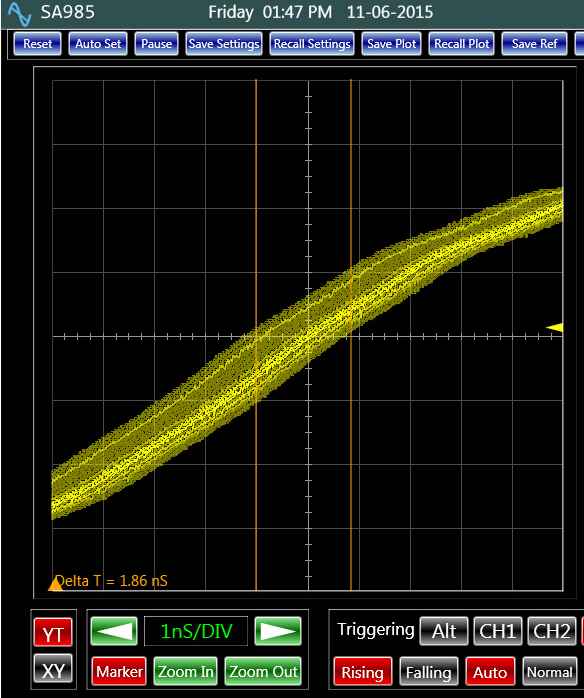 Often clock jitter induced from the power supply noise, signal routings, or other signals severely degrade the performance of the system. Clock generation and distribution in a FPGA for a high speed analog application is particularly prone to these issues. They manifest themselves in phase noise or clock jitter, which is the random variation of the period of a signal over time. Clearly, optimization of the design requires verification of the integrity of such clocks.
Rohde & Schwarz launches new Family of entry-level Mixed Signal Oscilloscopes
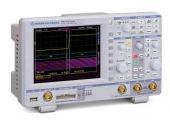 18 November 2015 - With the R&S HMO1202 mixed signal oscilloscopes Rohde & Schwarz introduces a new family of entry-level instruments. The R&S HMO1202 features a bandwidth of up to 300 MHz coupled with comprehensive math and FFT analysis functions. Two analog and eight digital channels, a sampling rate up to 2 Gsample/s, a memory depth up to 2 Msample, and a true vertical sensitivity of 1 mV/div are exceptional for instruments in the under EUR 2,000 price segment.
Harmonics Calculation Option for Motor Drive Analyzers
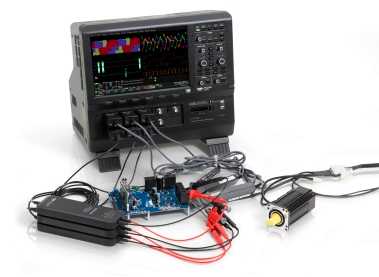 09 November 2015 – Teledyne LeCroy offers a new Harmonics Calculation option for the Motor Drive Analyzer (MDA800) series. This optional software package enhances the standard capabilities of the Motor Drive Analyzer software by adding advanced harmonic filtering for AC Input and Drive Output Numeric table measurements; Total Harmonic Distortion (THD) measurement parameters for voltage, current, and power; and a new Harmonic Order table with Spectral waveform displays. The Motor Drive Analyzer is built on the 8 channel/12-bit HDO8000 oscilloscope platform.
High-Sensitivity Current Probes with up to 120 MHz Bandwidth
 04 November 2015 - Yokogawa launched two new high-sensitivity current probes a for its families of mixed-signal oscilloscopes and ScopeCorders. The 701917, covering a frequency range from DC to 50 MHz, and the 701918, covering DC to 120 MHz, offer sensitivities ten times higher than previous models (typically 1 V/A) along with low noise levels of typically 60 µA RMS. They are ideally suited to the measurement of low-level currents from about 1 mA to 5 A.
MIPI D-PHY Support for Rohde & Schwarz R&S RTO Oscilloscopes
 27 October 2015 - A new option from Rohde & Schwarz permits R&S RTO oscilloscopes to trigger on DSI- and CSI-2 specific protocol data of MIPI D PHY interfaces and to decode the acquired waveforms into readable protocol content. The R&S RTO-K42 software option supports developers during the design, verification and debugging of MIPI D-PHY based interfaces. These interfaces are mainly used in cameras and displays in smartphones and tablets as well as in other electronic devices.
- Three new Modules for Yokogawa’s ScopeCorder Family
- Fully Automated MIPI M-PHY Transmitter Test Solution for Mobile Storage Devices
- Open Source USB Oscilloscope supports multiple Operating Systems
- Tektronix offers PAM4 Analysis Solution for Real Time and Equivalent Time Oscilloscopes
- Anritsu becomes Sales Representative for Teledyne LeCroy in UK and Ireland
- Tektronix expands ATI High Performance Oscilloscope Family with 50 GHz Model
- Ultra-Wide Bandwidth 5G Backhaul Signal Analysis
Page 57 of 78
Oscilloscope Basics |
Oscilloscope Probes – Vital Link in the Measurement Chain
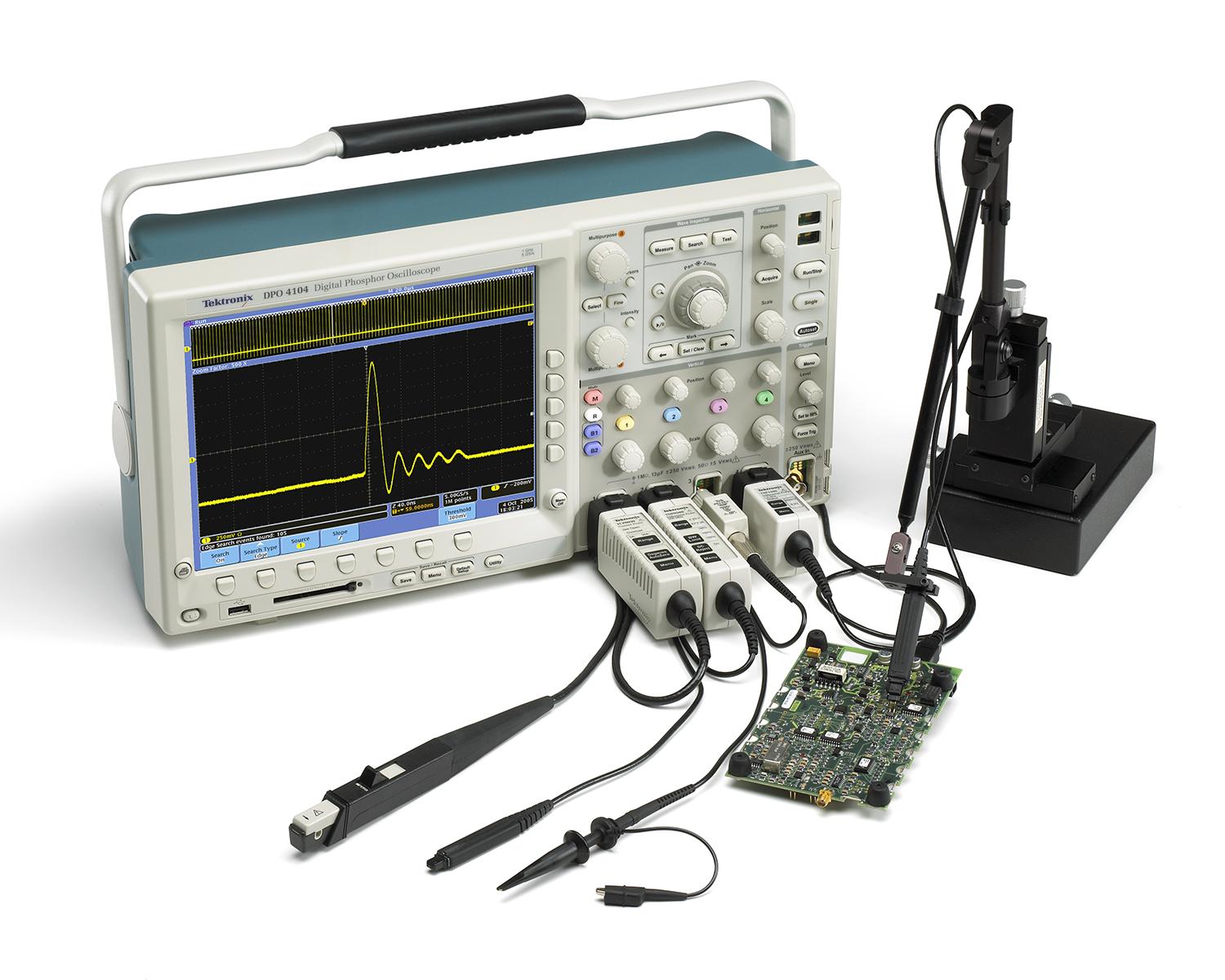 Signal measurement results can only be as accurate as the test and measurement tools in use. As clock rates and edge speeds of today’s electronic circuits increase, probing becomes a critical piece of the measurement system – the component that comes in direct contact with your circuit. This article looks at voltage probing considerations for embedded system and digital design debugging applications.
Oscilloscope Background |
A simple method to verify the bandwidth of your probe
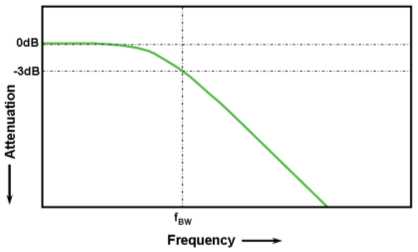 In oscilloscopes or oscilloscope probes, bandwidth is a measure of the width of a range of frequencies measured in Hertz. Specifically, bandwidth is specified as the frequency at which a sinusoidal input signal is attenuated to 70.7 percent of its original amplitude, also known as the -3 dB point. Most oscilloscope companies design the scope/probe response to be as flat as possible throughout its specified frequency range, and most customers simply rely on the specified bandwidth of the oscilloscope or oscilloscope probes, wondering if they are indeed getting the bandwidth performance at the probe tip. Now you can use these step-by-step instructions to simply measure and verify the bandwidth of your probe with an oscilloscope you may already have.